
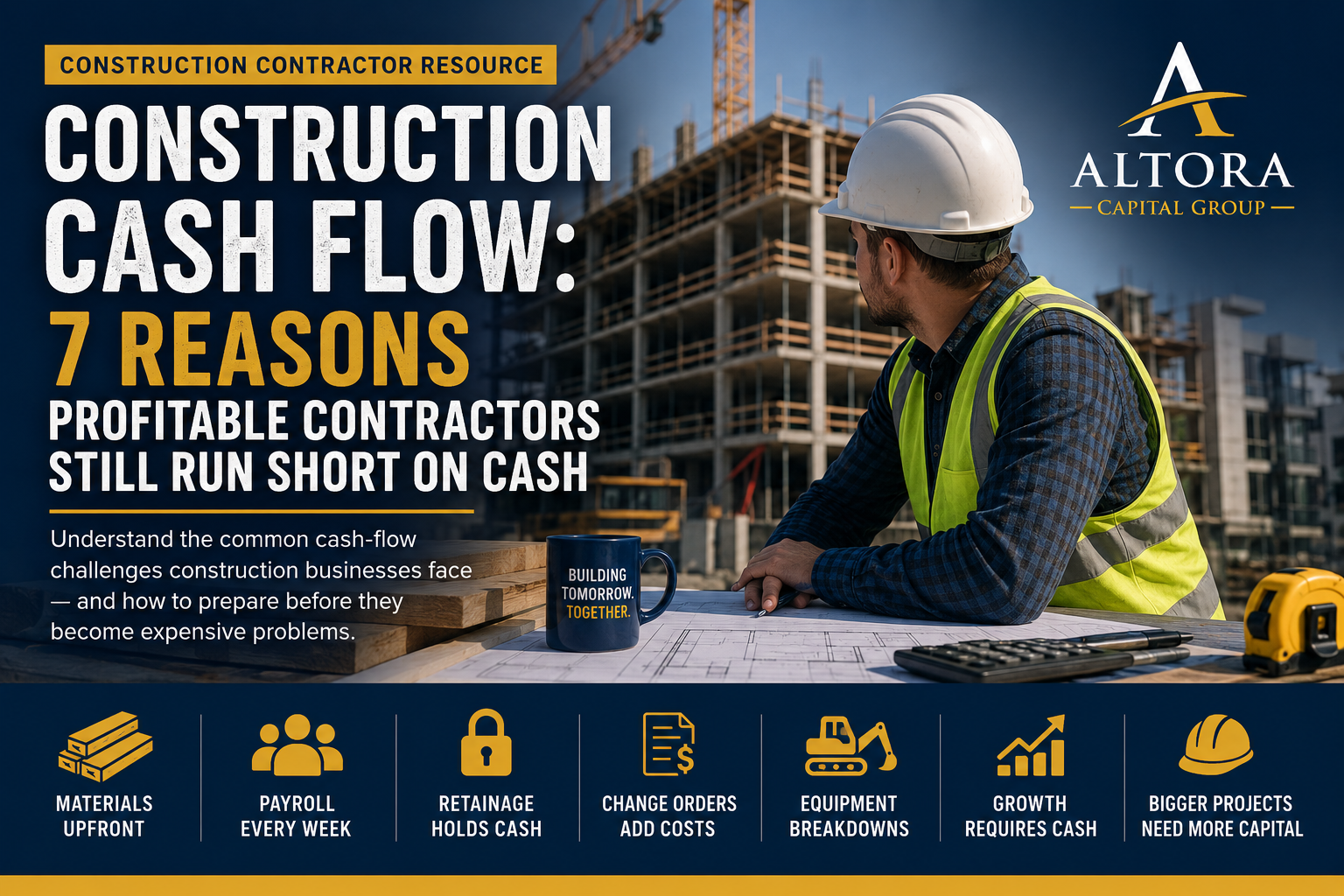
Construction Cash Flow: 7 Reasons Profitable Contractors Still Run Short on Cash
A full project schedule and strong revenue do not always mean cash is available when payroll, materials, equipment and operating expenses come due.
The jobs are booked. Crews are working. Revenue looks strong. Your company may even be having one of its best years.
So why can the checking account still feel uncomfortably tight?
Contractors often have to spend significant money long before they collect the full value of a project.
Materials need to be purchased. Crews need to be paid. Equipment needs fuel and repairs. Subcontractors may need deposits. Customers may pay slowly. Retainage may hold back part of your money long after the work is completed.
That creates a simple but important reality: a profitable construction company can still experience serious cash-flow pressure.
Here are seven reasons that happens—and why contractors should prepare before a temporary cash-flow gap turns into an emergency.
1. Materials Have to Be Purchased Before the Project Pays
Many construction projects require a significant investment before meaningful revenue ever reaches your bank account.
You may need to purchase:
- Lumber
- Concrete
- Roofing materials
- Electrical components
- Plumbing materials
- Fixtures
- Steel
- Equipment rentals
- Special-order materials
Even when a customer provides a deposit, that money may not cover everything required to begin or continue the job.
That number matters just as much as the total value of the contract.
2. Payroll Comes Every Week—Progress Payments Don't
Your crews expect to be paid on payday.
Your customer, general contractor or project owner may operate on a very different schedule.
A construction company may have thousands of dollars in approved work completed while still waiting weeks for a progress payment.
Meanwhile, payroll continues.
- Field crews
- Project managers
- Office staff
- Supervisors
- Drivers
- Estimators
A delay in receivables can create immediate pressure even when the underlying projects are profitable.
That does not necessarily mean there is a profitability problem.
It may simply be a timing problem.
3. Retainage Can Keep Your Money Tied Up
Retainage is common on many commercial and larger construction projects.
A portion of each payment may be withheld until certain project milestones are reached—or until the entire project is substantially complete.
That means your company may have already:
- Purchased the materials
- Paid your employees
- Paid subcontractors
- Covered insurance and overhead
- Completed the work
But some of the money associated with that work may still be sitting somewhere else.
Contractors need to understand how much money is tied up in retainage and how long it may remain unavailable.
4. Change Orders Can Create Hidden Cash-Flow Pressure
Construction projects change.
A customer changes the scope. Site conditions are different than expected. Materials need to be upgraded. Additional labor is required.
The change order may ultimately increase the value of the project—but your company may still need to perform and pay for the extra work before that additional revenue is collected.
That can mean additional:
- Materials
- Labor
- Equipment
- Subcontractor costs
- Project-management time
Small changes across several active projects can quietly consume a surprising amount of working capital.
5. Equipment Problems Don't Care About Your Budget
Construction businesses depend on equipment to produce revenue.
Depending on your company, that may include:
- Trucks
- Trailers
- Excavators
- Skid steers
- Loaders
- Compressors
- Generators
- Lifts
- Specialty tools
When a critical piece of equipment fails, the business can face two problems at the same time.
First, there is the repair or replacement cost.
Second, there may be lost production while the equipment is unavailable.
For some contractors, solving the equipment problem quickly can be more important than simply finding the lowest repair price.
6. Growth Can Consume Cash Faster Than Expected
Growth sounds like the opposite of a cash-flow problem.
But construction companies often have to spend money before growth produces additional revenue.
Adding another crew may require:
- Additional payroll
- Another truck
- Tools
- Equipment
- Insurance
- Uniforms and safety gear
- Training
- More materials
- Additional administrative support
The new crew may eventually generate far more revenue than it costs.
But the company often has to fund that growth first.
The same thing happens when a contractor suddenly wins several projects at once.
More work can mean more profit—but it can also mean more money leaving the business immediately.
7. Winning a Bigger Project Can Require More Cash Than You've Ever Needed
Landing the largest project in company history should be exciting.
And it is.
But before celebrating the contract value, ask another question:
A large project may require substantial upfront spending on:
- Materials
- Labor
- Equipment
- Subcontractors
- Permits
- Insurance
- Bonding
- Site preparation
The project can be highly profitable and still create a temporary working-capital gap.
Before committing resources to a large job, look beyond the contract value and understand:
- Upfront costs
- Deposit amount
- Progress-payment schedule
- Retainage
- Payroll requirements
- Material-payment terms
- Expected project duration
- Potential delays
- When the money is actually expected to reach your bank account
A $250,000 project does not help today's cash flow if most of the money arrives months from now.
Before Taking On the Next Big Project, Ask These Questions
Construction Cash-Flow Readiness Check
- How much working capital does the company normally keep available?
- How many weeks of payroll could we comfortably cover if a payment arrived late?
- How much money is currently tied up in receivables and retainage?
- What happens financially if a major truck or piece of equipment fails tomorrow?
- Could we afford the upfront costs of an unexpected large project?
- Do our deposits and progress payments match the timing of our actual project expenses?
- How much capital would another crew require before it became cash-flow positive?
- Do we understand our funding options before we actually need them?
The purpose is not to assume your company needs financing.
The purpose is to understand your cash-flow position and know what options exist before pressure forces you into a rushed decision.
Profitable Contractors Can Still Have Cash-Flow Gaps
There is an important difference between a business that does not have enough work and a profitable construction company experiencing a timing gap.
Contractors deal with those gaps constantly.
Materials need to be purchased before the draw arrives. Payroll comes before the customer pays. Retainage holds money back. Equipment breaks. Change orders add costs. A major project requires more working capital than expected.
None of those situations automatically mean financing is the right answer.
But they are good reasons to understand your numbers and know your options before the need becomes urgent.
Good cash-flow planning is not about borrowing more money.
It is about making sure a profitable opportunity does not become a financial problem simply because the timing of money coming in does not match the timing of money going out.
Have a Project, Equipment Need, or Cash-Flow Gap Coming Up?
Tell us what your construction business is trying to accomplish. We can talk through the situation and explore whether funding options may make sense.
SCHEDULE A CALLThis article is for general informational purposes only and is not accounting, tax, legal, or financial advice. Financing options, approval amounts, rates, terms, fees and eligibility requirements vary by provider and are subject to individual review and approval.